
What does “faxless” mean for a payday loan?
It means nobody asks you to find a fax machine. Fifteen years ago, an online payday loan often stalled at the same point: the lender wanted a pay stub, a bank statement and a void cheque, faxed over before it would release the money. Now that step happens on your phone. Your income is checked through your bank account or a document upload, the agreement is signed electronically, and the money arrives by e-Transfer or deposit.
Today, faxless is simply how licensed online lenders work. The word is still useful, because it points at the question people actually care about: what will the lender need from me, and is it safe to share?
- Faxless payday loan
- A payday loan applied for, verified and signed online, without paper documents. Same legal limits as any payday loan.
- Bank verification (IBV)
- A secure connection, run by a service such as Flinks or Inverite, that gives the lender a read-only copy of your bank account details and history.
- Document upload
- The fallback: PDFs or photos of pay stubs or statements, sent through the lender’s secure site.
How do lenders check your income without paperwork?
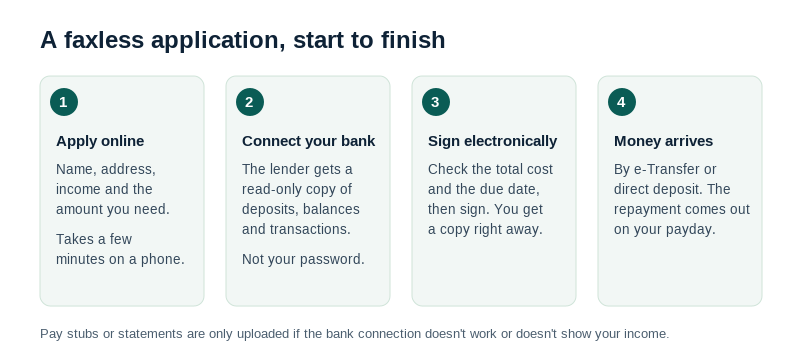
Most lenders use a bank verification service. During the application, a window opens where you pick your bank and sign in to it. The service then passes the lender the details it needs, and you never type your banking password into the lender’s own form. Flinks, one of the biggest services in Canada, has been owned by National Bank since 2021, and Inverite says it connects to more than 280 Canadian financial institutions.
The lender uses that data to answer three questions: is this your account, is your income regular, and can the repayment come out on payday without bouncing?
What can a lender see when you connect your bank?
More than a pay stub would show. “Read-only” means the lender can’t move money with the connection, but it does see a lot:
| Information | Bank connection | Faxed or uploaded documents |
|---|---|---|
| Your name and account numbers | Yes, read from the bank | From a void cheque or statement |
| Pay deposits | Yes, with dates and amounts | Only the stubs you send |
| Balances | Yes, current and available | On the statement date only |
| Spending and other loan payments | Yes, often months of history, sometimes up to a year | Only the pages you send |
| Bounced (NSF) payments | Yes | If they’re on the pages you send |
| Your banking password | No: entered with the verification service, not the lender | No |
So before you connect, it’s worth knowing what your recent months look like. Several payday loan payments, or a couple of bounced payments, are what most often turn a faxless application into a no. Our page on why payday loans get refused covers how lenders read that history.
One more thing to know: this kind of connection relies on you signing in through a third party, a method the federal government calls screen-scraping. It estimates that about nine million Canadians share their banking data this way, and says it raises security, liability and privacy risks. Canada’s Consumer-Driven Banking Act, passed in March 2026, will move this to safer, regulated connections, but draft rules were still out for comment in mid-2026, and the ban on screen-scraping wasn’t yet in force. Until then, only connect through a lender you’ve confirmed is licensed.
What will you need to have ready?
That depends mostly on how you’re paid and where your pay goes. Choose yours to see what a lender will likely ask for:
General guidance only: each lender sets its own document list. This runs in your browser and nothing is sent.
Without the checker, the short version is: your online banking sign-in for the connection window, the chequing account your income goes into, photo ID, and a phone and email you can check right away. Pay stubs or statements only come into it if the bank connection doesn’t work or doesn’t show your income clearly.
When will a lender still ask for documents?
- Your bank isn’t supported. Some smaller credit unions aren’t. Download 90 days of statements as PDFs and upload them.
- Your income doesn’t look regular. Cash deposits, gig payments or a recent job change mean the lender may want pay stubs or a letter from your employer.
- Your details don’t match. If the name or address on your application differs from your bank account, the lender will ask for ID or proof of address. Use your legal name and the address your bank has.
- The account isn’t yours alone. A joint account can work, but some lenders need the account in your name only.
Uploading is still faxless. It usually just adds a few hours while someone checks the files, which can cost you same-day funding if you apply late in the day.
What should you never send?
A lender’s legitimate requests stop at the list above. Treat any of these as a warning sign:
- Your banking password by email, text, chat or phone. The only place to type it is the bank-connection window during the application.
- A fee or deposit before you get the money. The Canadian Anti-Fraud Centre warns that fake lenders approve quickly, then ask for a fee to “secure” the loan, and the money never arrives. New Brunswick’s regulator adds that these sites can look convincing, down to licence numbers and e-signature tools.
- Your card number, PIN or a photo of your debit card. No lender needs them to pay you.
- Your SIN, unless you choose to. Federal guidance says you don’t have to give your SIN to apply for credit such as a credit card or line of credit, and a business can’t refuse you a product or service for declining when the law doesn’t require it.
Fake loan sites often use “no documents needed” as bait. Our page on loans without a credit check lists the other warning signs, and here’s how to check a lender’s licence before you share anything.
Is signing online as safe as signing in a store?
With a licensed lender, yes, and the same rules apply. In Ontario, the lender must give you a copy of the agreement immediately after you sign. Before you tap to sign, check three things on the agreement itself: the total cost in dollars, the exact date and amount of the withdrawal, and the lender’s name, which should match the licence you checked. In Ontario, Alberta and BC you can still cancel within two business days for free, online or not.
What are the rules in your province?
Faxless or not, a payday loan follows your province’s rules. In the nine provinces that license payday lenders, the cost is capped at $14 per $100, loans at $1,500 and terms at 62 days. Tap yours for its full rules and the lenders licensed there:
| Province | Most per $100 | Largest loan | Cancel at no cost | Regulator |
|---|---|---|---|---|
| Alberta | $14 | $1,500 | 2 business days | Service Alberta and Red Tape Reduction |
| British Columbia | $14 | $1,500 | 2 business days | Consumer Protection BC |
| Manitoba | $14 | $1,500 | See province page | Manitoba Consumer Protection Office |
| New Brunswick | $14 | $1,500 | See province page | Financial and Consumer Services Commission (FCNB) |
| Newfoundland and Labrador | $14 | $1,500 | See province page | Digital Government and Service NL |
| Nova Scotia | $14 | $1,500 | See province page | Service Nova Scotia (Consumer Affairs) |
| Ontario | $14 | $1,500 | 2 business days | Ministry of Public and Business Service Delivery and Procurement (Consumer Protection Ontario) |
| Prince Edward Island | $14 | $1,500 | See province page | Island Regulatory and Appeals Commission / Consumer Services |
| Saskatchewan | $14 | $1,500 | See province page | Financial and Consumer Affairs Authority (FCAA) |
Quebec, Yukon, Northwest Territories, Nunavut: no provincial payday-loan licence, so we don’t list payday lenders there. See other options
Full table with example costs on $300, $500 and $1,000, and a free CSV download
Quebec, Yukon, the Northwest Territories and Nunavut have no licensed payday lenders. There, a cash advance app, a small loan from your caisse or credit union, or an employer advance are the usual faxless options.
Are there faxless options that cost less?
Yes, and most of them use the same bank connection. Cash advance apps check your deposits the same way and charge little or nothing in interest, though their limits are small. Some credit unions, such as Vancity’s Fair & Fast Loan in BC, offer small online loans at a fraction of the cost. If your employer offers it, a salary advance may not need any verification at all. Compare the cost of each in the calculator, or see the full list of alternatives to payday loans.
If your income comes from benefits, our page on borrowing on EI, CPP or disability explains which lenders count them. For how the money gets to you once you’re approved, see e-Transfer payday loans, and to plan repayment around your pay schedule, the paycheck loan planner.
Ready to apply?
Koke’s application takes about three minutes and asks only what’s needed to match you with a licensed lender: no documents, no SIN, no banking password. If you’re matched, the lender may ask you to connect your bank to confirm your income, and you’ll see the total cost and due date before you sign anything. You can also compare lenders first.
Start my application Browse all lenders
Common questions
Do any payday lenders still ask for a fax?
Very few. Almost every licensed online lender in Canada now verifies income by connecting to your bank account or by having you upload documents. If a lender insists on a fax, ask why, and confirm its licence with your provincial regulator before sending anything.
Is a faxless payday loan cheaper or more expensive?
Neither. Faxless describes how you apply, not what the loan costs. In the provinces that license payday lenders, the most a lender can charge is $14 per $100 borrowed, whether you apply online, in a store or by phone.
Can the lender see my banking password when I connect my account?
It shouldn’t. You type your sign-in into a window run by a verification service, not into the lender’s form, and the lender receives the account details and transaction history, not your password. If anyone asks you to send your password by email, text or phone, stop: that’s a scam.
What does a lender see when I connect my bank?
Usually the account holder’s name, your transit, institution and account numbers, current balances and your transaction history, sometimes up to a year of it. That includes your spending, any other loan payments and any bounced payments, so expect the lender to factor those in.
What if my bank isn't on the list?
Download your last 90 days of statements as PDFs from your online banking and upload them instead. Most lenders accept that, though it can add a few hours while someone reviews them.
Can I get a faxless payday loan on benefits?
Often, yes. EI, CPP, OAS and disability payments show up clearly in your bank history, so the same bank connection can verify them. Whether a lender counts them as income is its choice, so check its requirements before you apply.
Do I have to give my SIN for a faxless payday loan?
No law requires it for a loan application. Many lenders ask for it to find your credit file more easily, but federal guidance says a business can’t refuse you a product or service just because you decline to give your SIN when it isn’t legally required.
Is it safe to sign a payday loan agreement online?
Yes, with a licensed lender. Read the total cost in dollars and the withdrawal date before you sign, and save the copy. In Ontario, for example, the lender must give you a copy of the agreement immediately after you sign it.