
What is a salary advance?
A salary advance is any way of getting paid before your scheduled payday. In Canada the term covers four quite different things, and the difference matters because their costs range from nothing to $14 for every $100:
- Employer pay advance
- Your employer pays you part of your wages early, and takes it back from a later paycheque. Usually free, but entirely up to your employer.
- Earned wage access (EWA)
- An app connected to your employer’s payroll lets you withdraw part of what you’ve earned so far this pay period. ZayZoon, based in Calgary, is one provider. It charges a flat fee per transfer, which some employers pay for you.
- Cash advance app
- An app you sign up for yourself, without your employer, that advances a small amount until your next deposit. KOHO, Bree, Nyble and Neo Advance work this way, with no interest.
- Payday loan
- A short-term loan from a licensed lender, repaid on your next payday, at up to $14 per $100 in the provinces that license them.
What does each kind of salary advance cost?
Put in the amount you need and how many days until you’re paid. The table works out what each route would cost, based on published fees and the Financial Consumer Agency of Canada’s example rates.
| Route | How it’s priced | Cost |
|---|---|---|
| Advance from your employer | Usually free; repaid from your next paycheque | $0 |
| Earned wage access app (through your employer) | Flat fee per transfer, about $5 at ZayZoon; some employers pay it | $5 |
| KOHO Cover | No interest; monthly subscription from $2 | From $2 |
| Bree | No interest; standard transfer listed as free, $2.99 to $45.99 for instant; check for a monthly fee | $0 standard |
| Overdraft protection | $5 fee plus 21% a year (FCAC example) | $7.42 |
| Credit card cash advance | $5 fee plus 23% a year (FCAC example) | $7.65 |
| Payday loan | $14 per $100, the legal maximum in provinces that license payday lenders | $42 |
Examples only. Employer, app and bank terms vary; overdraft and card figures use the Financial Consumer Agency of Canada’s example rates. App fees are as published in November 2026. Nothing you enter is sent anywhere.
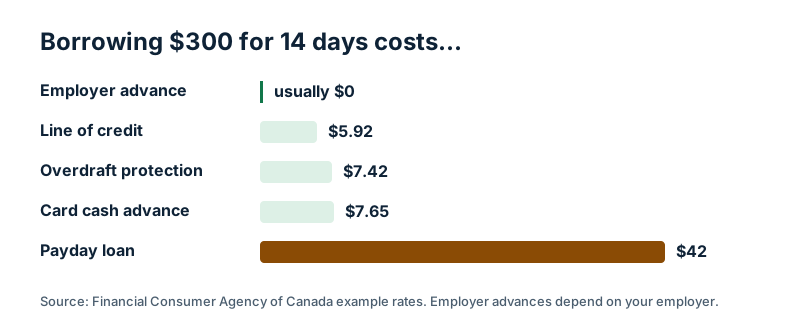
The gap is the whole story. A payday loan for $300 costs more than five times as much as overdraft or a cash advance on a card, and an employer advance usually costs nothing. That’s why it’s worth working down the list before taking a payday loan.
How do I ask my employer for a salary advance?
Many people never ask because it feels awkward. Employers get these requests more often than you’d think, and a short, specific message makes it easy to say yes. Ask in writing, say how much and why in one line, and offer a repayment plan. Something like:
Hi [name], I’ve had an unexpected [car repair / dental bill] and I’m short until payday. Would it be possible to get an advance of $[amount] on my pay? I’m happy to have it taken off my next paycheque, or split over the next two, and to sign whatever authorization payroll needs. Thanks for considering it.
A few things help: ask your direct manager or payroll rather than a group chat, ask for an amount you’ve already earned this pay period if you can, and keep the request private.
What are my rights when an advance is paid back?
Employment standards protect your pay. In Ontario, an employer can only deduct an advance from your wages if you’ve signed a written authorization that states the amount or how it’s calculated. A verbal agreement or a general clause in your contract doesn’t count. British Columbia also requires specific written authorization. Other provinces have their own rules; your provincial employment standards office can confirm them. Get the repayment plan in writing, and keep a copy.
How does earned wage access work in Canada?
If your employer offers it, earned wage access is usually the cheapest option after a straight employer advance. The app connects to payroll, works out what you’ve earned so far, and lets you take part of it early. Your employer’s next payroll deducts what you took.
- Cost: ZayZoon charges a flat fee per transfer, which ATB describes as $5. Some employers cover it, and ZayZoon also offers fee-free gift card payouts at partner retailers.
- Who can use it: only employees of a company that has signed up. Ask HR or payroll whether there’s an “on-demand pay” or “early pay” benefit; it’s sometimes there without much fanfare.
- Watch out for: getting into the habit. Taking part of every paycheque early leaves you shorter on payday, which can make next month harder.
Which salary advance apps work in Canada?
If your employer can’t help, a cash advance app is usually the next-cheapest route. None of these charge interest or require a credit check, according to Finder’s November 2026 comparison. They make money from subscriptions or instant-transfer fees.
| App | Amount | Fees | Income needed | Builds credit? |
|---|---|---|---|---|
| KOHO Cover | $20 to $500 | Subscription from $2 a month | None | No |
| Bree | $20 to $750 | Standard transfer listed as free; $2.99 to $45.99 for instant | Recurring direct deposits | No |
| Nyble | $30 to $250 | $11.99 a month for instant transfers | Over $1,000 in direct deposits | Yes |
| Neo Advance | $20 to $300 | Requires a $9.99 a month membership | None | Yes |
Check each app’s current terms before signing up, as fees change. A monthly subscription you forget to cancel can quietly cost more than the advance saved you. KOHO is the only one with a full profile on Koke so far; for more on how it works, see borrowing without a credit check.
When does a payday loan make sense instead?
Only when the cheaper routes aren’t open to you: your employer says no, you don’t have an overdraft or a card with room, and the app limits are too small. A payday loan can go up to $1,500, and many lenders pay the same day. But it costs up to $14 for every $100, and it’s due in full on your next payday. If you go this route:
- borrow only what you need, and make sure you can repay it and still cover rent and food;
- use a lender licensed in your province; here’s how to check;
- read about what a payday loan really costs, or try your numbers in the calculator;
- if you need it today, here’s how same-day payday loans work.
What are my options in my province?
Employer advances, earned wage access and most apps work the same way across the country. What changes is payday lending and wage-deduction rules. In the nine provinces that license payday lenders, the cost is capped at $14 per $100; you’ll find each province’s limits on the rules by province page, and local lenders and free help on your province or city page.
In Quebec and the territories there are no licensed payday lenders. Quebec residents can still use KOHO Cover, Nyble and Neo Advance, according to Finder, and a caisse populaire may offer a small personal loan or overdraft.
What if a salary advance won’t be enough?
If you’re borrowing against every paycheque, an advance only moves the gap. A few things can help more:
- Call the company you owe and ask for more time or a payment plan. Utilities, phone providers and landlords often agree if you ask before the due date.
- Ask your bank or credit union about a small loan or overdraft; credit unions such as Libro and FirstOntario publish rates far below any payday loan.
- Talk to a non-profit credit counsellor. It’s free, and they can help you build a plan if debts are piling up. If a payday loan is already part of the problem, see help with payday loan debt.
More ideas, including government help, are on the alternatives to payday loans page.
Still need to borrow?
If the cheaper routes aren’t available, Koke’s application takes about three minutes. Our matching partner looks for a licensed lender whose rules fit your answers, and you see the full cost before you sign. You can also compare lenders side by side first.
Start my application Browse all lenders
Common questions
Can my employer refuse a salary advance?
Yes. No province requires an employer to advance wages you haven’t been paid yet; it’s a favour or a workplace policy, not a right. Many employers will say yes for a genuine emergency, especially if you ask early and suggest how it will be paid back.
Can my employer take the advance back from my next paycheque?
Usually, if you agree in writing. In Ontario, an employer can deduct from your wages only with a written authorization that states the amount or how it’s calculated; a verbal okay or a general clause isn’t enough. BC also requires specific written authorization. Other provinces have similar rules, so check your province’s employment standards office.
Is earned wage access a loan?
Providers describe it as early access to wages you’ve already earned, not a loan, and there’s no interest. You typically pay a flat fee per transfer, which some employers cover, and the amount comes off your next paycheque. It’s only available if your employer has signed up.
Do salary advance apps check my credit?
KOHO, Bree, Nyble and Neo Advance don’t require a credit check, according to Finder’s November 2026 comparison. Some want regular direct deposits instead: Nyble asks for more than $1,000 in direct-deposit income and Bree for recurring deposits on consistent dates, while KOHO has no income requirement.
Can I get a salary advance if I live in Quebec?
Yes, but your choices are narrower. Quebec doesn’t license payday lenders, and many advance apps aren’t offered there, though Finder reports that KOHO Cover, Nyble and Neo Advance are. An advance from your employer, or a small loan from your caisse populaire, is often the best route.
Will a salary advance affect my credit score?
An employer advance or earned wage access isn’t reported to the credit bureaus. Among the apps, Nyble and Neo Advance report payments, which can help build credit, while KOHO and Bree don’t. A payday loan usually isn’t reported unless it goes to collections, and then it can hurt your score.
How much can I get as a salary advance?
From an employer, whatever you agree on, usually part of pay you’ve already earned. Advance apps currently go from $20 up to $250 at Nyble, $300 at Neo Advance, $500 at KOHO and $750 at Bree. A payday loan can go up to $1,500, but at a much higher cost.
Is a salary advance better than a payday loan?
Almost always, on cost. Using the Financial Consumer Agency of Canada’s example of $300 for 14 days, a payday loan costs $42, while overdraft or a card cash advance costs under $8 and an employer advance is usually free. A payday loan makes sense only when the cheaper routes aren’t available to you.