
What is a paycheck loan?
It’s a loan you borrow against your next paycheque and repay in full when that paycheque lands. Americans call it a paycheck loan; in Canada it’s legally a payday loan, and each province that allows them sets the rules. Online, the whole thing happens on your phone: you apply, the money arrives by e-Transfer or deposit, and the lender takes the repayment from your account on payday.
- Paycheck or payday loan
- Up to $1,500, one repayment on your next payday, at no more than $14 per $100 where provinces license them.
- Pay or salary advance
- Part of your own wages paid early by your employer or a payroll app. Usually much cheaper. See salary advances in Canada.
- Instalment loan
- A larger loan repaid over several paycheques, at up to 35% a year. Easier on a single payday, but costs more over time.
How much can I borrow against my paycheque?
Less than you might think, and that’s partly by design. Enter your province, how often you’re paid, and your take-home pay to see the most you could borrow, what it would cost and what you’d have left.
An estimate at the legal maximum cost; a lender may charge less, offer less than you ask for, or decline. It runs in your browser and nothing is sent.
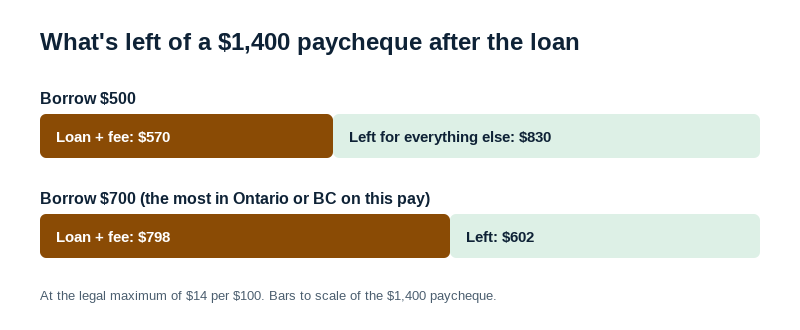
The question that matters isn’t how much a lender will give you. It’s whether what’s left after the repayment still covers rent, food and bills until the following payday. When it doesn’t, people take a second loan to cover the gap, and the fees start stacking up.
When is a paycheck loan due?
On your next payday, in most cases. That makes your pay schedule decide how long you have the money, and how expensive the loan is when you work out a yearly rate:
| Paid | Typical loan length | Fee on $500 | As a yearly rate |
|---|---|---|---|
| Every week | About 7 days | Up to $70 | About 730% |
| Every two weeks | About 14 days | Up to $70 | About 365% |
| Twice a month | About 15 days | Up to $70 | About 341% |
| Once a month | About 30 days | Up to $70 | About 170% |
In every province that licenses payday lenders, a loan can’t run longer than 62 days. If you’re paid weekly and the next payday is too close for comfort, ask the lender whether it can set the due date to the payday after; lenders can set terms up to that limit, so it’s worth asking.
How do online paycheck loans get repaid?
Almost always by pre-authorized debit: you agree to let the lender withdraw the full amount from your chequing account on the due date. A few practical things save trouble:
- Check the withdrawal date, not just the payday. If your pay usually clears in the afternoon and the lender withdraws in the morning, the payment can bounce.
- Tell the lender if your pay date changes, because of a new job, a holiday or a payroll switch, before the due date.
- Know the bounce fees. Your bank charges its own NSF fee. The lender’s charge for a bounced payment is capped at $20 in Manitoba, New Brunswick, Newfoundland and Labrador, Nova Scotia, Ontario, Prince Edward Island and Saskatchewan.
- Pay early if you can. Repaying before payday is allowed and shouldn’t cost you more.
Changed your mind after signing? In Ontario, Alberta and BC you can cancel within two business days for free.
What if my next paycheque won’t cover it?
Call the lender before the due date, not after. Some provinces require lenders to offer a longer repayment plan to people who borrow repeatedly, and many lenders will talk about a payment arrangement rather than chase a bounced payment. Taking a new loan from another lender to pay the first one is how a single paycheck loan becomes several; in Ontario, Alberta and BC a lender can’t give you a new payday loan while one is still outstanding anyway. Our page on what to do if you can’t repay walks through your options, and a non-profit credit counsellor can help for free.
How do I get a paycheck loan online?
- Work out the amount with the planner above, so you know you can repay it and still get through the next pay period.
- Pick a lender licensed in your province. Each lender profile shows where it’s licensed; here’s how to check a licence with your regulator.
- Have your pay stub or bank statement ready. Lenders confirm your pay dates and amounts from it. Not paid by an employer? Our page on borrowing on benefits covers EI, CPP and disability income.
- Read the agreement: the total cost in dollars and the exact withdrawal date.
- Watch for the money, usually by e-Transfer. Applying on a weekday morning gives you the best chance of getting it the same day.
If you’ve been turned down before, here’s why applications get refused and what usually fixes it.
What are the rules where I live?
Licensed payday lenders work in British Columbia, Alberta, Saskatchewan, Manitoba, Ontario, New Brunswick, Nova Scotia, Prince Edward Island, and Newfoundland and Labrador. All nine cap the cost at $14 per $100, the loan at $1,500 and the term at 62 days. Ontario and BC add the half-your-pay limit. Tap your province for its full rules and the lenders licensed there:
| Province | Most per $100 | Largest loan | Cancel at no cost | Regulator |
|---|---|---|---|---|
| Alberta | $14 | $1,500 | 2 business days | Service Alberta and Red Tape Reduction |
| British Columbia | $14 | $1,500 | 2 business days | Consumer Protection BC |
| Manitoba | $14 | $1,500 | See province page | Manitoba Consumer Protection Office |
| New Brunswick | $14 | $1,500 | See province page | Financial and Consumer Services Commission (FCNB) |
| Newfoundland and Labrador | $14 | $1,500 | See province page | Digital Government and Service NL |
| Nova Scotia | $14 | $1,500 | See province page | Service Nova Scotia (Consumer Affairs) |
| Ontario | $14 | $1,500 | 2 business days | Ministry of Public and Business Service Delivery and Procurement (Consumer Protection Ontario) |
| Prince Edward Island | $14 | $1,500 | See province page | Island Regulatory and Appeals Commission / Consumer Services |
| Saskatchewan | $14 | $1,500 | See province page | Financial and Consumer Affairs Authority (FCAA) |
Quebec, Yukon, Northwest Territories, Nunavut: no provincial payday-loan licence, so we don’t list payday lenders there. See other options
Full table with example costs on $300, $500 and $1,000, and a free CSV download
In Quebec, Yukon, the Northwest Territories and Nunavut there are no licensed payday lenders, and every lender is held to the federal 35% annual cap. A pay advance from your employer, an advance app such as KOHO, or a small loan from your caisse or credit union is the usual route there.
Is there a cheaper way to bridge to payday?
Usually. Ask your employer for an advance on wages you’ve already earned; it’s often free. Overdraft protection or a credit card cash advance costs a fraction of a payday loan for the same few days; the calculator puts them side by side. If you need more than a paycheque can repay, an instalment loan spreads it out, though it costs more overall. You’ll find more ideas on the alternatives to payday loans page, and the scam warning signs on our page about loans without a credit check.
Ready to apply?
Koke’s application takes about three minutes. Our matching partner looks for a licensed lender whose rules fit your pay and answers, and you’ll see the total cost and due date before you sign. You can also compare lenders first.
Start my application Browse all lenders
Common questions
Is a paycheck loan the same as a payday loan?
Yes. “Paycheck loan” is the American spelling and “paycheque loan” the Canadian one, but in Canada the product is legally a payday loan: up to $1,500, repaid in a single payment, usually on your next payday, at no more than $14 per $100 in the provinces that license them.
Do I need a job to get a paycheck loan?
You need regular income going into a chequing account, but it doesn’t have to be a paycheque. Many lenders accept pensions, EI and other regular benefits. In Ontario, a payday lender can accept proof of Ontario Works or ODSP payments.
What happens if my payday falls on a holiday?
Your employer usually pays you the business day before, and the lender’s withdrawal can still run on the original date, or the next business day. Check the exact withdrawal date in your agreement, and if your pay date moves, tell the lender before the due date so the payment doesn’t bounce.
Can I change the due date if I get paid on a different day?
Ask the lender before you sign; the due date is normally set to your next payday. If your pay schedule changes after you’ve borrowed, contact the lender straight away. It may move the withdrawal, but it isn’t obliged to, and the loan can’t run longer than 62 days.
How much does it cost if my repayment bounces?
Two fees can land at once: your bank’s NSF charge and the lender’s. In Manitoba, New Brunswick, Newfoundland and Labrador, Nova Scotia, Ontario, Prince Edward Island and Saskatchewan, the lender’s charge for a bounced payment is capped at $20. Keep the repayment amount in your account the morning it’s due.
Can I pay a paycheck loan off before payday?
Yes. You can repay early, and the fee shouldn’t go up because you did. Call or log in to your lender account before the scheduled withdrawal so it isn’t taken twice.
Why do paycheck loans cost more for people paid weekly?
The fee is the same, up to $14 per $100, but you have it for fewer days. Over one week that works out to about 730% a year; over a month, about 170%. The dollar cost is identical; the yearly rate just shows how expensive the credit is for its length.
Will a paycheck loan show up on my credit report?
Most payday lenders don’t report on-time payments, so repaying won’t build your credit. If you don’t repay and the debt goes to a collection agency, that can appear on your report and lower your score.