
The four marks of a real payday loan
Four things, and a real lender will have all four. They come from provincial law, not from how polished a website looks:
- A licence where you live. The lender holds a payday lender licence in your province, listed on your regulator’s register, not just a licence somewhere else in Canada.
- A legal price. The fee is within your province’s limit. In the provinces that license payday lenders, that’s at most $14 per $100 borrowed, and Ontario requires the cost to be shown as an annual percentage rate too.
- A written agreement you can back out of. You get the agreement, with the total cost and the due date, before you commit, and you get a copy. In Ontario, Alberta and British Columbia you can cancel within two business days at no cost; other provinces set their own cancellation rules.
- Money first, payment later. The loan reaches you before you pay anything. The fee is part of what you repay on payday.
Licensing doesn’t make a payday loan a good deal: at $14 per $100, it’s still one of the most expensive ways to borrow. But it decides whether the rules protect you at all.
Follow the money
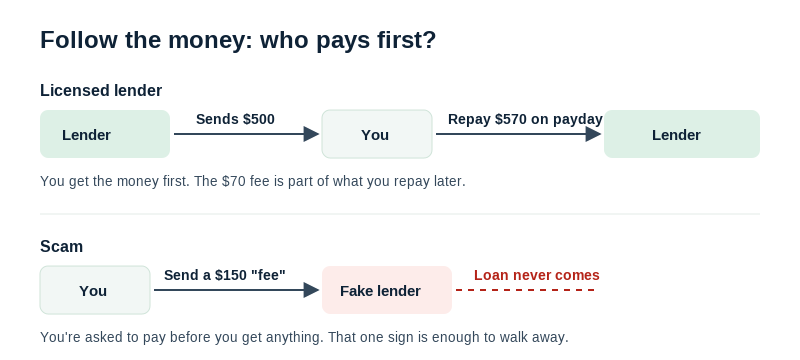
If you only remember one thing from this page, make it this. Fake lenders “approve” you quickly, then ask for an insurance, processing or deposit fee to release the money, and the money never comes. Ontario’s rules spell out the opposite: a payday lender can’t ask for any part of the cost of borrowing before the loan’s end date.
It’s a costly mistake. Canadians reported losing more than $704 million to fraud in 2025, and the Competition Bureau says only 5% to 10% of frauds are reported at all.
Test the offer you’ve been given
Enter what you’ve been offered and tick anything that has happened. The checker compares the fee with your province’s legal limit and explains each warning sign:
A guide, not a verdict on any company: always confirm the licence with your regulator. This runs in your browser and nothing is sent.
The checker can tell you whether an offer looks like a scam. It can’t confirm that a lender is licensed, which only takes a minute on your regulator’s site; here’s how to check a payday lender’s licence, step by step.
It also helps to know what a real lender will ask you for. Our page on how lenders verify you without paperwork covers that; anything beyond it, such as a password or a fee, is a warning sign. Koke itself never asks for your SIN, your banking password or an upfront payment.
Can an offer be too cheap to be real?
Yes, and it’s the warning sign people miss, because a low price feels like good news. In April 2026, Alberta RCMP warned about fake online lenders offering loans with unusually low interest rates and fast approval, mostly targeting foreign workers. Once victims shared their personal and banking details and paid a fee, the “lender” stopped answering. The victims lost the fee and were left exposed to identity fraud.
Payday loans have a known price. If a company you’ve never heard of offers short-term cash for far less than a bank would charge, ask why. The few genuinely cheap options, such as cash advance apps, credit union small loans and employer advances, come from organizations you can look up and recognize. Our list of alternatives to payday loans names them.
The opposite matters too. A quote above your province’s limit means the lender isn’t licensed for payday loans, or the product isn’t a payday loan at all.
How scammers borrow a real lender’s name
Scam sites rarely invent a brand from scratch. They borrow credibility:
- Look-alike names and websites. A real company’s name with one word added, or a familiar logo on a new domain. Alberta’s Consumer Investigations Unit keeps a running list of fake websites that claim to be Alberta businesses.
- Real-looking details. New Brunswick’s regulator notes that fake lending sites may show a licence number, a tax number and e-signature tools to look genuine.
- A move off the website. Alberta RCMP list requests to continue the conversation on private messaging apps as a warning sign.
- Ads and messages that come to you. An offer you didn’t ask for, by text, social media or phone, deserves extra suspicion.
The defence is to start from the regulator, not the lender. Find the company on your province’s register, then go to the website the register lists, typed in yourself, rather than following an ad or a link someone sent you. On Koke, payday lender profiles link to the regulator’s register for each province, so you can confirm the licence yourself.
Lenders, brokers and sites like Koke
It depends what they do and who pays them. There are three kinds of business you might deal with:
| Type | What it does | What it should cost you |
|---|---|---|
| Licensed lender | Lends you the money and collects the repayment | The fee in the agreement, within the legal limit |
| Loan broker | Arranges a loan with a lender for you | Nothing extra. In Ontario, brokers must be licensed and the Payday Loans Act doesn’t allow payments from borrowers to brokers |
| Comparison or matching site | Lists lenders or passes your application to one | Nothing. It’s usually paid by lenders, and it should tell you so |
Koke is the third kind. We don’t lend, we never charge you, and we may be paid when you apply through our links, as our affiliate disclosure explains. If a site in any of these categories asks you for money before you have a loan, leave.
Licensed doesn’t always mean fair
A licence is a floor, not a promise of good service. What it gives you is a set of rules you can hold the lender to. Ontario’s, for example, say a lender collecting a debt can’t contact your family or household, can’t call you more than three times in seven days, and can’t use threatening or intimidating language. Other provinces have similar limits.
Watch for the legal-but-costly moves too: being offered a larger amount than you asked for, add-on products sold with the loan, or a new loan to cover the old one. If a licensed lender breaks the rules, complain to it in writing first, then to your provincial regulator, whose contact details are on your province’s page. If you’re struggling to repay, see what happens if you can’t repay; and if you’ve changed your mind, here’s how to cancel a payday loan.
Find your province’s register
Each province sets its own limits, licence register and complaint process. Choose yours to see them, along with the lenders we’ve found licensed there:
| Province | Most per $100 | Largest loan | Cancel at no cost | Regulator |
|---|---|---|---|---|
| Alberta | $14 | $1,500 | 2 business days | Service Alberta and Red Tape Reduction |
| British Columbia | $14 | $1,500 | 2 business days | Consumer Protection BC |
| Manitoba | $14 | $1,500 | See province page | Manitoba Consumer Protection Office |
| New Brunswick | $14 | $1,500 | See province page | Financial and Consumer Services Commission (FCNB) |
| Newfoundland and Labrador | $14 | $1,500 | See province page | Digital Government and Service NL |
| Nova Scotia | $14 | $1,500 | See province page | Service Nova Scotia (Consumer Affairs) |
| Ontario | $14 | $1,500 | 2 business days | Ministry of Public and Business Service Delivery and Procurement (Consumer Protection Ontario) |
| Prince Edward Island | $14 | $1,500 | See province page | Island Regulatory and Appeals Commission / Consumer Services |
| Saskatchewan | $14 | $1,500 | See province page | Financial and Consumer Affairs Authority (FCAA) |
Quebec, Yukon, Northwest Territories, Nunavut: no provincial payday-loan licence, so we don’t list payday lenders there. See other options
Full table with example costs on $300, $500 and $1,000, and a free CSV download
Quebec, Yukon, the Northwest Territories and Nunavut don’t license payday lenders. If you live there, a website offering you a payday loan isn’t operating under any payday rules that protect you. A caisse, credit union or cash advance app is the safer route. For a side-by-side view of every province, see payday loan rules by province.
What if you’ve already paid or shared your details?
- Call your bank now. Ask it to stop or reverse the payment, block further withdrawals and, if you shared your banking sign-in, lock the account.
- Change your passwords, starting with online banking and the email account linked to it.
- Report it to the Canadian Anti-Fraud Centre at 1-888-495-8501 or online, and to your local police. Report it even if you didn’t lose money; it helps stop the next attempt.
- Protect your credit. Ask Equifax and TransUnion to add a fraud alert, so new credit in your name gets an extra check.
- Tell your provincial regulator, especially if the scam used a real lender’s name.
Then expect a second wave. The Canadian Anti-Fraud Centre reports fraudsters posing as the CAFC, or as investigators working with it, to target people who were already scammed, sometimes with fake letters bearing its logo. No real agency charges a fee to recover your money.
Questions about spotting a real lender
How can I tell if a payday loan company is legitimate?
Check four things: it holds a payday lender licence in your province (search the regulator’s register, not the lender’s own site), its fee is within your province’s limit, it gives you a written agreement before you sign, and it sends you the money before asking you to pay anything.
Do legitimate lenders ever charge an upfront fee?
No. A licensed payday lender takes its fee out of what you repay on your due date. Ontario’s rules, for example, say a lender can’t ask for any part of the cost of borrowing before the end date. A request for an “insurance”, “processing” or “release” fee before funding is the classic sign of a scam.
Is a lender legitimate if it has a licence number on its website?
Not necessarily. Scam sites copy real licence numbers and company names. Search the regulator’s register yourself and check that the business name and website listed there match the site you’re on.
Can an offer be too cheap to be real?
Yes. Alberta RCMP warned in 2026 about fake online lenders offering interest rates well below what banks or licensed lenders charge, plus fast approval. The low rate is bait for a fee and your personal details.
Are payday loans legal in every province?
Payday loans are licensed in British Columbia, Alberta, Saskatchewan, Manitoba, Ontario, New Brunswick, Nova Scotia, Prince Edward Island, and Newfoundland and Labrador. Quebec, Yukon, the Northwest Territories and Nunavut don’t license payday lenders, so an online “payday lender” offering loans there should be treated as unlicensed.
Are loan comparison and matching sites legitimate?
Many are, but check what they are. A comparison site like Koke doesn’t lend money and shouldn’t charge you anything; it may be paid by lenders, which it should say plainly. In Ontario, payday loan brokers must be licensed too, and the law doesn’t allow borrowers to pay a broker.
What should I do if I paid a fake lender?
Call your bank right away to try to stop or reverse the payment, report it to the Canadian Anti-Fraud Centre at 1-888-495-8501 and to your local police, and ask Equifax and TransUnion to add a fraud alert to your credit file. Change any passwords you shared.
Someone says they can get my money back from a loan scam. Is that real?
Be very careful. The Canadian Anti-Fraud Centre reports fraudsters posing as the CAFC itself, or as investigators working with it, to target people who have already been scammed. Real agencies don’t charge a fee to recover your money.